Cookie Warning


A Warning from Poirot:

Mon Ami, allow me to warn you of a possible danger of reading this blog. Although I'm not a programmer, I understand that cookies may be used on this blog. So if your computer, tablet, phone (etc.) finds cookies objectionable, please peruse these posts with a cookie-friendly internet-surfing device.
Showing posts with label Arthur Hastings. Show all posts

Monday, January 20, 2020

Alain Paillou and The Big Four

Captain Hastings travels to Dover, England

Agatha Christie's novel The Big Four doesn't get much love. When it was published in 1927, literary critics saw it as uninspired paste-up drawn from earlier stories. The TV series, Agatha Christie's Poirot, waited until their last season to adapt it, and utilized little beyond a few characters and scenes in their version. Agatha Christie, in a letter to her agent, supposedly called the novel "rotten."

Captain Hastings reunites with his friend Hercule Poirot

Yet many fans regard the novel with great affection, and it's easy to see why. Its title calls to mind the Sherlock Holmes novel The Sign of Four, and Agatha Christie repeatedly alluded to Arthur Conan Doyle's characters and stories in her novels. Beyond that, the novel exudes a big screen quality far grander than most of its successors. 
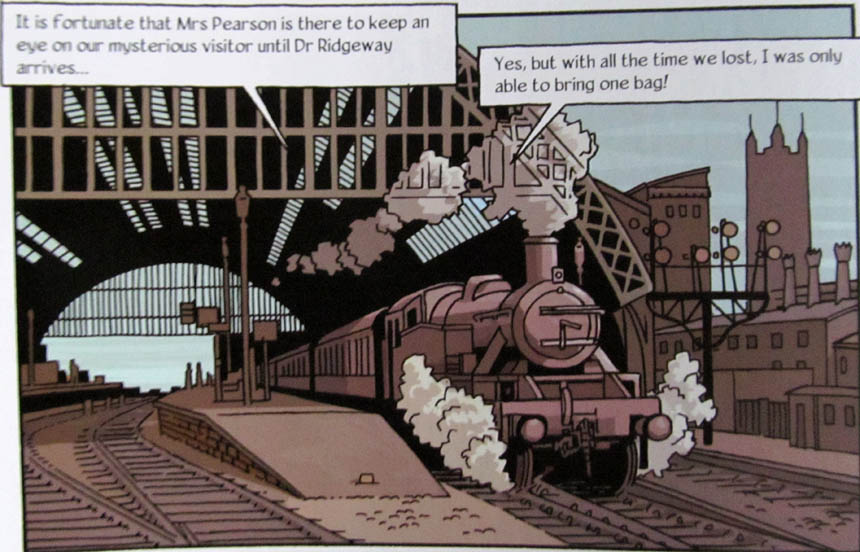
Poirot and Hastings depart London to investigate the Big Four

While Agatha Christie usually held back, and constrained her characters' actions, here she lets go, and shows what she could do if she let her imagination really fly. Thus we see Poirot leaping off moving trains, actually traveling to countries instead of sending for information, and teaming with the military to invade the lair of a villain set on world domination. 

Their investigations take them to Paris, France.

Likewise, his friend Arthur Hastings becomes more of an action-man. He even goes undercover at one point. Of course, he suffers a few knocks, but that's all in the line of duty for this British patriot and former Army Captain.


Poor Hastings!

We may never see a televised adaptation, let alone a big screen release, that does justice to The Big Four. But Alain Paillou's graphic novel gives us a taste of what could be achieved, if filmmakers and the Christie estate greenlit a production. The artwork evokes the times in which Agatha Christie's story is set, and takes us to such evocative locales as London, Dartmoor Prison, Paris, and to the Dolomites.


Poirot and Hastings question a murder suspect

Unlike the graphic novel, the latter is a mountain range in Italy, not a tasty treat. Nonetheless, I'm sure that, wherever you are, you can buy or make a few tantalizing delights to enjoy while you sit back and immerse yourself in Alain Paillou's The Big Four. 

A man dies under mysterious circumstances in Poirot's apartment.

Thus, while you follow Hercule Poirot's investigations, you could make a real event of the reading, and indulge all your senses. Might I suggest a box of chocolates? That could prove the perfect accompaniment to this exciting reading experience, given the little Belgian's culinary tastes.

Oh no, not the beautiful Countess Rossakoff again!

Just make sure the cover of the package matches the box. Otherwise, you could be taking your life into your hands by eating those oh-so-temping confections.

Dragon Dave


Monday, June 4, 2018

Hyoscine, Amorite, the Mousetrap, and Oh Yes, More Spills!

In Agatha Christie's Poison Garden
Torre Abbey, Torquay, England


In Agatha Christie's play Black Coffee, the Amory family finds a selection of drugs previously kept by Edna, one of Sir Claud Amory's daughters. Like the author, Edna worked in a dispensary during World War I, during which she accumulated this cache. Since the war, Edna has settled in India, while her father Sir Claud, the famed scientist, has worked on a formula to split the atom. 

Among "the spoils of war," as the family members term the collection, they find Iodine, Castor Oil, Morphine, and a drug called Hyoscine. Dr. Carelli, a houseguest, states that an overdose of Hyoscine would bring no pain, but merely a dreamless sleep from which one would never awaken. Lucia, the daughter-in-law of Sir Claud, is seen taking some of the Hyoscine pills. 

After Sir Claud dies, the doctor pronounces that the scientist was poisoned. Naturally, the only thing that stands between Lucia and a murder charge is Hercule Poirot.


Deadly Nightshade, from which Hyoscine is made,
Torre Abbey, Torquay, England


According to Matthew Pritchard, Agatha Christie's grandson, the author wrote Black Coffee in 1929 after a stage adaptation of her novel The Murder of Roger Ackroyd disappointed her. The play, adapted to novel form by Charles Osborne, offers a unique and interesting insight to the author's views on life, as well as the consciousness of the age. Most of us think of the Manhattan Project in the 1940s as the beginning and end of the development of the atomic bomb. Yet a decade-and-a-half before the United States dropped atomic bombs on Japan during World War II, Christie's character Sir Claud is working on a formula for splitting the atom.

While his family view him as stern, stingy, reclusive figure, the world cherishes the scientist as a benefactor, despite the destructive nature of his research. Sir Claud dubs his finished formula Amorite, which seems odd, as most people know that the Spanish word "amor" is translated as love. The world loves Sir Claud Amory, and in return, he will share the fruits of his labor, Amorite, with the world? While making social commentary on human nature, Christie is unknowingly foretelling how the fruits of military researchers will blossom in the future.

As in The Mysterious Affair at Styles, Hercule Poirot visits the grand country house. There, he cannot help rearranging unsymmetrical items on a mantlepiece. Again, the item that concerns him most is a spill vase. Every time he enters the room, he sees the spill vase has been moved. At the novel's climax, he connects one of the witnesses' comments with the rolled up scrap paper used to transfer fire from fireplace to fireplace. "What is it I have in this vase?" he asks his friend and companion Hastings.

"Why, spills, of course," Captain Hastings replies.

"No, mon ami, it is cheese," Poirot replies. "You use it to bait a mousetrap."

In the early 1950s, Christie wrote her most famous play. The Mousetrap would go on to become the longest-running play in world history. I've never scene it performed, or read an adaptation. I don't know if it contains Hyoscine, Amorite, or even spills kept in a spill vase above a fireplace. But twenty years earlier, Christie seems to be sowing creative seeds she will reap two decades later when she likens the spills to cheese for a mousetrap.

And as for those paper spills, which people used to save money over the more expensive matches? After Hercule Poirot saves Lucia from a charge of murder, the famous scientist's daughter-in-law lights a match, uses it to burn the spill, and then tosses the burning paper into the fireplace. How's that for taking family story elements, and presenting them in a new and interesting way?

Dragon Dave

Monday, September 18, 2017

Captain Hastings' Inspiring Counterparts


Agatha Christie's first published novel was The Mysterious Affair at Styles. The story introduced the world to Hercule Poirot, a former Belgian policeman, now a refugee in England. Her second published novel, The Secret Adversary, took a very different look at the detective novel. Instead of having a professional solving crimes, this time two young amateurs do the sleuthing. Their names are Tommy and Tuppence, and their only criterion for solving crimes is their desire to do so. Yet, in their own way, they prove just as effective as their better known predecessor, Hercule Poirot.

As in The Mysterious Affair at Styles, Agatha Christie begins her novel by rooting it in real life events. This time, it's not Belgian refugees fleeing the Third Battle of Ypres, but the sinking of RMS Lusitania. While there was an espionage element to The Mysterious Affair at Styles, this time that aspect is even more pronounced. A government official entrusts secret papers to a young American woman, believing she has a better chance of surviving and reaching England than himself. Although the young woman reaches England, she goes missing shortly thereafter. In addition to locating the girl, the British government desperately wants those classified documents. When an international espionage organization threatens to publicize these papers, the English intelligence community must martial all its resources to reclaim the papers before they can be published, or risk riots, a governmental shakeup, even war.

Usually, government officials would call upon someone with a great deal of experience to investigate, such as Hercule Poirot, and his literary predecessor, Sherlock Holmes. Instead, two out-of-work young people stumble upon the mystery of the missing girl. After they make a promising start, the British Intelligence community bankrolls Tommy and Tuppence investigative efforts. 

Agatha Christie began The Mysterious Affair at Styles with Captain Arthur Hastings pondering what he'll do after the war. One idea he considers is becoming a detective. However, Poirot's brilliance puts him to shame, and the story suggests that solving crimes is best left to the professional. With Tommy and Tuppence, Agatha Christie places the everyman in the role of detective. Hercule Poirot and Sherlock Holmes may not think much about Captain Arthur Hastings and Doctor John Watson as detectives, but former WWI soldier Tommy Beresford and war volunteer Prudence "Tuppence" Cowley use their imagination, common sense, enthusiasm and self-belief to uncover clues and make progress in their investigations. 

The effect upon the reader is stunning. We may not be dazzled by Tommy and Tuppence, but we share a camaraderie with them. Most of us could never honestly view Hercule Poirot as an intellectual equal, but we can relate to Tommy and Tuppence. We can see ourselves filling their shoes, using our own skills of observation and ingenuity to solve crimes. Like Captain Arthur Hastings, they believe they can become detectives if they really want to. Unlike The Mysterious Affair at Styles, The Secret Adversary doesn't merely entertain: it inspires and empowers us. Agatha Christie's second novel suggests that if we can marshal sufficient belief in ourselves, we can accomplish the seemingly impossible. And maybe, in so doing, we can change our world for the better.

The world can always use brilliant people like Sherlock Holmes or Hercule Poirot. But I'd also like to think we could use more people like Tommy and Tuppence, don't you?

Dragon Dave

Thursday, November 19, 2015

Captain Hastings on Golf And Cars

While it's always interesting to speculate as to how the people and events in an author's life inspire her to include them in her story, what we know is that the production team chose to rewrite Agatha Christie's original stories. Often, they did this to strengthen the bond between Hercule Poirot and Hastings, as proved the case with this story. In the TV version, Poirot and Hastings travel to France on holiday. Somewhat bizarrely, a perfectionist like Poirot, who always needs everything just so, leaves the entire planning of this vacation to Captain Hastings. A man who cares about all the little details, who needs everything symmetrical and suited to his tastes, entrusts his friend, who takes a much more casual view of life, to choose the hotel? It may not make sense, but it does endear us to Hastings, who pushes back the porter at the train station when the man attempts to hand him his golf clubs. 


Hastings knows that Poirot dislikes the game of golf. Poirot's aims for this trip are different. He wishes to explore the glorious realms of French cuisine. In the car, he casually asks Hastings what hotel he has chosen. Then the great detective sees the taxi pulling up at the Hotel Du Golf. As Poirot leaves the car, we feel for Poirot when he warns Hastings that the chef's cooking had better be acceptable to his palate. Hastings quickly assures Poirot that he's sure the food is up to scratch. After all, you can work up a healthy appetite after playing 18 holes!

Thankfully for Hastings, Poirot finds the food at the Hotel Du Golf acceptable. Even better, the rich Mr. Renault (note the slight name change) shows up in the hotel lobby. There he sits by Poirot, and urgently requests his assistance. Poirot shushes him, and agrees to call on his tomorrow at his house. Perhaps Poirot shushes Renault because he does not wish to disturb his friend Captain Hastings. If so, he need not worry, as Hastings is thoroughly absorbed by the beautiful lady singer. 

The TV series presented Captain Hastings as having a passion for automobiles. Poirot, meanwhile, views them merely as a necessity. So swapping the name of an obscure French nobleman for one shared by a company with a rich heritage in racing and automotive history seems like another way to involve Hastings further in the story. Consider Hastings' agony in the TV version of The Murder on the Links. He plans a magnificent vacation in France, only to have his golf plans ruined with the murder of a fellow golf enthusiast. Worse, the name of the victim is synonymous with that of the famed Renault car company. What a catastrophe!

Dragon Dave

Tuesday, October 27, 2015

Captain Arthur Hastings' Modern Girlfriend

In Agatha Christie's novel The Murder on the Links, Captain Arthur Hastings takes a ferry across the English Channel, then rides on a train back to London. There he returns to the apartment he shares with Hercule Poirot, the famous Belgian detective. Unlike most of his countrymen, Poirot opted to remain in England after the war. Over breakfast the next morning, Hastings and Poirot catch up, and Poirot reiterates how glad he is not to have traveled on the ship with Hastings. Even in the calmest weather, and even for an hour, Poirot finds the notion of a voyage aboard a ship unpalatable. 

In its own way, sea sickness can be as debilitating as a fear of air travel. 

After breakfast, Poirot goes through his morning mail. In it he finds a letter from France. When he opens it, he discovers it is an appeal for help from a Mr. Renauld. Even though the rich gentleman doesn't say exactly what he wants Poirot to investigate, he insists that he lives in fear of his life. Despite his dislike of sea voyages, the urgent tone of the letter convinces Poirot to travel to France and meet Mr. Renauld. And even though he's just returned from France on a business trip for the government, Hastings agrees to return, this time to help his friend with this mysterious investigation. 

When they reach Mr. Renauld's house in France, Poirot and Hastings discover that he was kidnapped. Mrs. Renauld was found in the house by a servant, bound and gagged. The police expected to receive a ransom demand from the kidnappers. Instead, the body of Mr. Renauld is discovered on the golf course adjoining his estate. It seems Mr. Renault was murdered, stabbed in the back.

I won't attempt to summarize Agatha Christie's novel for you. Nor do I wish to throw out any spoilers that might diminish your interest in the story. But as to the girl Hastings met in the first chapter, aboard the train headed toward Calais, he bumps into her the following day.


As on the train, he can't resist telling her he's investigating a murder. She declares that she's mad about murders, and sweet-talks him into showing her the scene of the crime. I like how Agatha Christie shows us how repulsive Hastings views this modern woman's interests and actions, tells himself how much he dislikes her, but can't resist acceding to her requests. Clearly she wields a power over him. For although he knows the French police will surely object, he gives her a tour of the crime scene anyway.

The TV adaptation changes a great many things about this girl Hastings meets. Agatha Christie's girl is a coarse dance hall entertainer. The girl in the TV version works as a refined, elegant singer in the hotel where Hastings and Poirot take lodgings. In the book, Higgins fights his constant attraction to her. On TV, she is instantly everything he's ever desired in a woman. In the book, his growing attraction to her is much more of a mystery in itself. On TV, it's the typical storybook romance we've seen a thousand times. In Christie's novel, Hastings doesn't even know her name until two-thirds of the way through the novel. Even then he only thinks he knows it, and Poirot must set him right as to her true identity many pages later. In TV, Hastings learns her name immediately, but tells the French police and Poirot that he doesn't. Of course, the French police may believe his story, but Hercule Poirot knows the woman's identity. For he saw how his friend Arthur Hastings gazed at her when she sang in the hotel lobby.

I found these two different versions of Arthur Hastings' romance with his modern girlfriend satisfying and enjoyable. Having watched Agatha Christie's Poirot on TV for over twenty years now, I am finding that exploring the stories as she wrote them, and comparing them to the TV versions, enhances my appreciation for both. Still, it is interesting how TV rips apart and reassembles what works in Christie's novels in order to translate her stories into a new medium. Don't you agree, mon ami?

Dragon Dave 

Tuesday, May 26, 2015

Hastings Complains In Poirot Investigates


Most evenings, my wife and I read a few pages of a story before we drift off to sleep. Right now, we're about halfway through Poirot Investigates, the third book Agatha Christie published that featured her ingenious detective Hercule Poirot. Like the first two novels, The Mysterious Affair at Styles and The Murder On The Links, the short stories in this collection are narrated by Captain Hastings. Unlike the first two novels, I'm not enjoying them. Or, at least, not as much as I wish I were.

Part of the problem is that I'm not in love with the short story form. When I read, I care about the characters, and a novel gives the author lots of pages to explore that. With a short story, the author has to focus in on the action, the plot, and underpinning idea. So I suppose that's some of the reason for my dissatisfaction with the book.

I think the major reason I'm not enjoying this collection though is because of how Agatha Christie portrays Captain Hastings. In Poirot's first novel, The Mysterious Affair at Styles, Hastings might have initially fancied the idea that he was smarter than Poirot, but he also showed great respect for Poirot's instincts and deductions. That's not to say that he never questioned his friend's decisions, but he went along with (what seemed to him) the little Belgian's wackiness more often than not. In The Murder On The Links, however, Hastings seems to be chafing at his friend's actions, and calling into question everything he says and does. Perhaps not verbally, but at least inside himself. I came away from that second novel feeling that Hastings had felt Poirot was wrong every step of the way during the investigation. That's not to say I didn't enjoy Hasting's role in the second novel. Christie really takes him on personal odyssey, and he sort of grows-up by the end of the novel. It's as if he's been clutching onto his friendship with Poirot because he's not really to venture on ahead with his life, whereas by the end of The Murder On The Links he's ready to be his own man. So I enjoyed that aspect of his part of the novel. I just didn't enjoy the complaining, distrusting, thinking-Poirot-is-wacky part.

This theme continues in Poirot Investigates. Perhaps people who read the Hercule Poirot stories before they saw the TV series based on these stories will feel differently, but the Poirot and Hastings I fell in love were the 50 minute adaptations. Each episode expanded upon the story it was based upon, and screenwriters such as Clive Exton infused them with character, strengthening the bonds between Hercule Poirot, his secretary Miss Lemon, Chief Inspector Japp, and especially (or so I felt) his friend Captain Hastings. The Hastings in the TV series might have questioned Poirot, might have gently begged to differ with him, but the Hastings in Christie's stories sometimes grows so angry with Poirot that he storms off at the end of the story, and needs weeks until he can stand being with Poirot again. When he reappears in the next one, he may be over his previous huff, but he's all too eager to think his friend is wacky again.

I used to think it was a shame that Agatha Christie didn't put Captain Hastings in more of the novels. Now I think I understand her reasoning. She needed someone to call into question everything Poirot did, and after awhile it seems tiresome and unrealistic if the same sidekick is doing that. So she brings in other characters who don't know him so well to fulfill that function, and ultimately, be amazed by his brilliance. 


Look at these two. They're firm friends. They practically exude affection and mutual respect. That's the Captain Hastings that I fell in love with, that I want to encounter again and again: the TV version of Hastings, not the one Agatha Christie created. I'd hang out with him any day, any time. More importantly, so would Hercule Poirot. Still, if Agatha Christie hadn't created her Hastings, screenwriters such as Clive Exton couldn't have created the version I love.

Still, who knows? I might feel entirely different about Captain Hastings by the time I finish the remaining stories in Poirot Investigates. Maybe, for whatever reason, I'm just in a huff.