Agatha Christie's second Hercule Poirot novel, The Murder on the Links, starts with Captain Arthur Hastings riding on a train in France. In his carriage, his sole companion is a young lady who goes against all his classic ideas of what a woman should be. She swears, says the most outrageous things, and wears too much makeup. Yet, despite all this, he finds himself strangely attracted to her.
As they talk, Hastings opens up to her, and tells her that the landscape they are traveling through reminds him of his experiences during World War I. Like many of his friends, he fought in the great war, and saw many people of his generation die. The scenery especially reminds him of the Battle of the Somme, which was waged between July and November 1916. After receiving serious injuries, he was invalided out of France. He was sent to a manor house that had been converted into an Army hospital, where he recovered from his wounds. Thereafter, he never returned to active service on the battlefield. Instead, during the remainder of WWI, he served the British Army in lesser capacities.
The Battle of the Somme was one of the bloodiest battles of World War I. In all, roughly one million people were killed or wounded. Hastings, who recovered fully from his injuries, is one of the lucky ones. Despite his breezy, unaffected manner, it's easy to understand how deeply such an experience would scar him for life.
Recently, Hastings has been working for a British M.P. (or Member of Parliament), and on this occasion his duties took him to France. But he doesn't seem heavily involved in his government work. Aside from the occasional trip abroad,he may sit idle for days or weeks. So as he travels with the girl toward Calais, he tells her about his friend Hercule Poirot, the famous detective, and how he sometimes helps him investigate his cases. In particular, he references the poisoning of Mrs. Emily Ingelthorp at Styles Court, which Agatha Christie covered in the first Hercule Poirot novel, The Mysterious Affair at Styles. When the train reaches the station, Hastings reluctantly disembarks and parts company with her.
As the train steams off to its next destination, this beautiful young woman seems to walk out of his life. Although he looks for her, he doesn't see her when he boards the ferry that will take him across the English Channel.
As I mentioned previously in my post, The Mysterious Battle of Ypres, in the TV version of The Mysterious Affair at Styles, we found Captain Arthur Hastings recovering from his injuries in a converted English manor house. Unlike today, he has no continuously broadcasting TV channels such as the BBC or CNN to watch. Nor can he read reports posted on a continuously throughout the day on his laptop or cell phone. The only source of news he gets comes via newspapers and newsreels. When we first see him, he sits in a darkened room, and the film projector shows him footage from the recent Third Battle of Ypres. This battle, also known as the Battle of Passchendaele, was waged in Belgium, and the resultant destruction spurred a mass exodus of refugees to other countries. Shortly after that, at the invitation of his friend John Cavendish, he visits Styles Court. There, he meets up with Hercule Poirot, one of many Belgians who has fled the fighting to resettle, at least temporarily, in England.
The Third Battle of Ypres occurred between July and November of 1917, a year after the Battle of the Somme. I wonder why the TV adaptation of The Mysterious Affair at Styles was set later than Agatha Christie wrote the novel, in 1917. Why would the production team ignore Captain Hastings conversation with this young lady on the train in The Murder on the Links, which clearly dates the Styles affair in 1916? I understand why the people behind the series chose to set all the Poirot stories between WWI and WWII, as opposed to letting the later novels appear as Agatha Christie wrote them, such as the 1960s and 1970s. Still, given that decision, it seems odd to set productions of Agatha Christie's first two Poirot novels later than she did.
Anyone else find this as strange as I do?
Related Poirot And Friends Posts
The Mysterious Battle of Ypres
Cookie Warning
Mon Ami, allow me to warn you of a possible danger of reading this blog. Although I'm not a programmer, I understand that cookies may be used on this blog. So if your computer, tablet, phone (etc.) finds cookies objectionable, please peruse these posts with a cookie-friendly internet-surfing device.
Tuesday, October 6, 2015
Thursday, September 24, 2015
A Conversation at the Quay
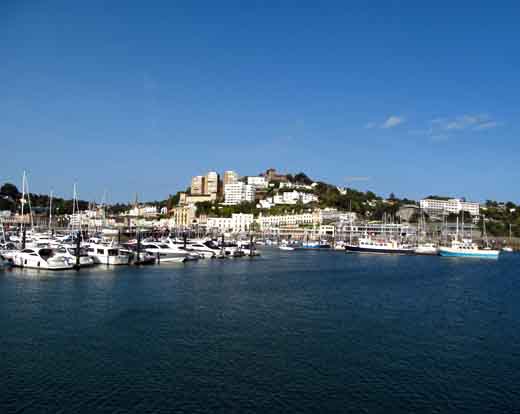
No more beautiful sight exists in Torquay than the quay itself. Ships come and go in the azure waters, and the shore-side roads are bordered by restaurants, hotels, and shops and kiosks selling every manner of goods every associated with a pleasant, seaside holiday. My wife and I strolled past these businesses, our attention divided by the tantalizing items for sale, the ships in the harbor, the people swimming in the water gently lapping against the shore, or playing in the pebbly sand, and our fellow human and canine walkers. Yet we had come with an interest in mind beyond that of most tourists. This was Agatha Christie's hometown, and as we walked, we saw not only what is today, but also tried to picture our surroundings as the great author would have seen them, decades and yes, even a century ago.
Make no mistake: for the Agatha Christie fan, all of Torquay is hallowed ground.
I make no claims to being a diehard Agatha Christie fan. I'll admit I've read a dozen or so of her books. For some authors, such as the obscure, mostly forgotten (but nonetheless great) E. F. Benson, that might be impressive. But given the number of books she produced in her lifetime, and her legion of fans who know her stories inside and out, I'm a nobody. Nor can I claim that my motives in reading her are pure, as I've started to read her work in the last few years, having thrilled to the performances of actor David Suchet on the TV adaptations of "Agatha Christie's Poirot." But now that I am reading her novels, I'm finding that what I perceived as sprawling among riches was really just the oblivion of the uniformed. For Agatha Christie's novels possess the riches far greater than those the TV series could ever hope to capture. Her novels know none of the limitations of a tightly budgeted TV production. Her narratives feel no need to keep Hercule Poirot foremost and center. In some books, he hurtles off on boats and trains, and goes to far-flung destinations. In others, he rarely appears. Thus, in the TV productions, even the most faithful show striking differences with the source material. And at times, the resultant shows barely resemble the original stories.
While walking the historic boardwalk, the wind whipped over the water. This forced me to keep my hat tightly strapped down, and its bill pointed down, lest the wind rip it off my head and cast it upon the gleaming blue water. Given the long summer days, and the clear skies, taking off one's sunglasses could only force one to squint. Yet in such a picturesque setting, photographs seemed mandatory.
We passed by one family, who were taking turns taking photographs of each other with their iPads, as the beauty of their surroundings had exhausted the batteries in their cameras. We offered to take a photo of all three of them with their iPad, and in return, they took a photo of us with our camera. Then we fell into conversation.
When the subject turned to Agatha Christie, and Hercule Poirot, their eyes lit up. Yes, they too were fans, drawn to the stories by the TV series. Yes, they too loved David Suchet's performances, and it was the love of those adapted stories that had drawn them here. They wished to see where the author had lived. They also admitted that, as the TV production for all the Poirot stories had finally wound down, they were being drawn to read her original books. I told them some of the differences I had discovered, between her original stories, and the adaptations, by reading her novels. From their smiles, and the brightness of their eyes, I came away feeling as if they now felt even more driven to seek out those differences for themselves.
I greatly enjoyed the time I spent in Torquay, and treasure my memories of all I experienced there. While I would have loved to attend many of the events scheduled for this year's Agatha Christie Festival, I suspect the times that would have meant the most to me would have been the conversations with other fans, such as the one I enjoyed with the family on the boardwalk. But then, after we left the boardwalk, my wife and I stepped inside a small shop to look for postcards, and a cheerful, enthusiastic lady behind the counter insisted upon having us taste three or four flavors of ice cream made with real Devonshire cream. In the end, I chose Banoffee, a mixture of Banana and Toffee. Sitting down outside, and watching the people walking past, the bathers swimming or playing in the pebbly sand, and ships parked in or navigating the gleaming azure waters, while we ate our authentic Devonshire ice cream, remains another treasured memory.
Perhaps, Mon Ami, we could even call it a Hercule Poirot moment. For even if the scoops of ice cream in my bowl weren't identically-sized and symmetrically-placed, I'm sure the great detective would have approved of the flavor.
Thursday, September 17, 2015
Agatha Christie's Murder Garden
Gardens play a significant role in many Agatha Christie stories. Consider a few examples. In her first novel, The Mysterious Affair at Styles, the day on which the gardener works near the house proves a vital clue for Hercule Poirot, as does the woman who sits reading in the garden, where she can hear an argument taking place inside the house. In her third Hercule Poirot novel, The Murder of Roger Ackroyd, Poirot has tired of conducting his sleuthing from his flat in London. He retires to a village where he buys a house, and grows marrows (squash). Although he applies his little gray cells to this task successfully, raises exceptionally healthy and large vegetables sure to compete favorably in the village show, he grows so dissatisfied with his life there that he picks up and hurls a marrow over the fence, narrowly missing the doctor who lives next door. And in Nemesis, Miss Marple accepts the challenge of a dead man (through his lawyer), and agrees to carry out an investigation, even if at the outset she doesn't know precisely what she is supposed to investigate. As events unfold, she soon learns she has been invited to join an all-expenses-paid garden tour. As the bus travels between towns and great English Manor houses, and she tours these carefully manicured gardens, she meets many interesting people. Gradually, she begins to understand the mystery her deceased benefactor wished her to investigate.
As we toured the English county of Devon on this year's trip, we found flowers blooming in boxes, containers, and hanging baskets on nearly every street of every town we visited. Torquay, Agatha Christie's hometown, showed off many impressive gardens. There we discovered one dedicated to the writer. It holds a number of flowers and plants mentioned in her stories. From these plants, the poisons used in her novels can be produced. This garden resides within the walls of Torre Abbey. We enjoyed seeing all these plants, and racking our brains for the answers to the trivia questions on the placards.
Today we're so used to getting medicines and poisons in specially marked containers that we tend to think of them as only things that can be produced in the most sophisticated laboratories. Agatha Christie's stories remind me of a time when people lived closer to nature, and knew how to utilize and appreciate what sprang naturally from the soil. True, sometimes they used these fruits-of-the-earth for terrible purposes, but I'm sure that the majority of the time that closeness to nature enhanced their lives in innumerable ways.
If you live in England, and are attending the International Agatha Christie Festival, you can get a guided tour today of the writer's murder garden at Torre Abbey. If you'd like to visit Torquay someday, consider adding the gardens of Torre Abbey to your prospective itinerary. Either way, when you get there, take a moment to appreciate the beauty of all those plants. Bend close to inhale the sweet fragrance of the flowers. But whatever you do, don't contemplate taking a nibble of the leaves or petals. The consequences could be...deadly.
Tuesday, September 15, 2015
Agatha Christie's Offensive Masterpiece
Agatha Christie is one of the best selling English writers of all time. Although I read a few of her novels in my youth, my main experience with her until recently has been through TV, chiefly in the ITV productions starring David Suchet as her famous detective Hercule Poirot. Eventually watching the TV adaptations returned me to reading her novels and stories. I found her novels a sublime pleasure, even if the Poirot stories differed radically from the TV versions, and didn't feature such likable characters as the TV versions of Captain Hastings, Miss Lemon, and Inspector Japp. This love affair with her stories led me to visit cities and places strongly associated with her, such as London, Dartmoor, and Torquay, and the creation of a Poirot-themed blog as well.
Ironically, the first book of hers that I remember reading did not feature her famous detectives Hercule Poirot or Miss Marple. It's her bestselling book of all time, the novel she considered her masterpiece, and the one she found hardest to write. While it was released in Britain as Ten Little Niggers, American publishers titled it And Then There Were None. Yet I read a copy of it bearing another title: Ten Little Indians.
Strangely, I don't remember being all that impressed by it, when I read it back in High School. At the time, it seemed formulaic, and the title (actually, any of the titles) leached any long term tension from the narrative. So it seems odd to me that the novel has been embraced so completely by everyone else in the world, instead of being criticized, lambasted, and universally hated for bearing such racially-charged titles. Given how people often find reasons to slam a work of art for any imaginable flaw, and even generate an uproar sufficient to destroy an author's career, everyone who has read the book must absolutely adore it. Either that, or they love her so much that they're willing to forgive her for such offensive, seemingly inexcusable titles.
Were I visiting Torquay today, I could attend the Princess Theatre.
There, in recognition of Christie's 125th birthday, I could see a live production of And Then There Were None.
I could also attend a panel discussing, in part, the making of the forthcoming BBC adaptation of this novel. The production will feature Sam Neill, whom I first saw in the third Omen movie, and went on to star in Hollywood blockbusters like "Jurassic Park," "The Hunt for Red October," and "Event Horizon." It will also feature Miranda Richardson, who may be best known for her role as journalist Rita Skeeter in the Harry Potter movies, but whom I shall always remember for her role of Queen Elizabeth the First, or "Queenie," in the "Blackadder" TV shows. Hopefully, the TV production will make its way over to the states soon.
In the meantime, perhaps I should reacquaint myself with Christie's novel. It's got to be infinitely better than my recollection of that High School reading experience, don't you think?
Ironically, the first book of hers that I remember reading did not feature her famous detectives Hercule Poirot or Miss Marple. It's her bestselling book of all time, the novel she considered her masterpiece, and the one she found hardest to write. While it was released in Britain as Ten Little Niggers, American publishers titled it And Then There Were None. Yet I read a copy of it bearing another title: Ten Little Indians.
![]() |
| Photo courtesy of the Torquay Museum, which has devoted a wonderful exhibit to Christie's life and her stories. |
Strangely, I don't remember being all that impressed by it, when I read it back in High School. At the time, it seemed formulaic, and the title (actually, any of the titles) leached any long term tension from the narrative. So it seems odd to me that the novel has been embraced so completely by everyone else in the world, instead of being criticized, lambasted, and universally hated for bearing such racially-charged titles. Given how people often find reasons to slam a work of art for any imaginable flaw, and even generate an uproar sufficient to destroy an author's career, everyone who has read the book must absolutely adore it. Either that, or they love her so much that they're willing to forgive her for such offensive, seemingly inexcusable titles.
Were I visiting Torquay today, I could attend the Princess Theatre.
![]() |
| Princess Theatre, Torquay, England |
There, in recognition of Christie's 125th birthday, I could see a live production of And Then There Were None.
I could also attend a panel discussing, in part, the making of the forthcoming BBC adaptation of this novel. The production will feature Sam Neill, whom I first saw in the third Omen movie, and went on to star in Hollywood blockbusters like "Jurassic Park," "The Hunt for Red October," and "Event Horizon." It will also feature Miranda Richardson, who may be best known for her role as journalist Rita Skeeter in the Harry Potter movies, but whom I shall always remember for her role of Queen Elizabeth the First, or "Queenie," in the "Blackadder" TV shows. Hopefully, the TV production will make its way over to the states soon.
In the meantime, perhaps I should reacquaint myself with Christie's novel. It's got to be infinitely better than my recollection of that High School reading experience, don't you think?
Friday, September 11, 2015
An Agatha Christie Celebration
Our trip to England in 2013 took us to the Hilton in Brighton, where we attended the World Fantasy Convention. While I enjoyed the panel discussions, readings, and meeting some favorite authors (including Peter F Hamilton), I wished for more interaction with other readers. It can be difficult at times to talk with people about the books you read, as so many people have and still do write wonderful and inspiring stories. Unless you belong to a book group, where you focus on a particular novel, you're often reduced to telling others about books they haven't read, and authors they may not have even heard of.
Book groups can disappointing for a different reason. To appeal to as many interests as possible, group leaders rarely focus on a single author, or for even a specific genre. And what happens when the group convenes to discuss a particular book? A third to a half of the people will say they haven't finished it, if they even bothered to read it. Then they, and half of those that did, will tell you why they didn't like it. Leaders can also be a pain. They do their research, and then when you share elements of the book you enjoyed, and something positive you took away from reading it, they'll inform you that you're wrong, that they have proof that the author intended to communicate something completely different with his story!
I don't know about you, but I'd love to gather together with other people who like the authors I like, who have read the stories I've read, and want to share how the stories challenged, delighted, entertained, and inspired them. A single-author group, if not a convention, seems an ideal setting for that. And if production companies have adapted the author's stories for TV and movies, so much the better. So much more to talk about! The only question, in the case of a convention, is this: Can you attract sufficient number of fans to pay the costs of such an event?
Thankfully, given Agatha Christie's popularity, this isn't a problem. In fact, people come from all across the globe to see the places she lived and wrote her stories. She grew up in Torquay, a seaside town in south Devon, married her first husband there, and started her career there. After her second marriage, she may have moved away, but she purchased an estate (Greenway) in Torquay, and returned to spend her summers there. So Torquay seems an ideal place to meet to discuss and celebrate her work, given all the associations the city holds for her family and life.
This year's International Agatha Christie Festival takes place in Torquay, and celebrates the 125th anniversary of her birth. There will be lots of events geared toward every age group and interest, and the ten day event kicks off tonight at the Grand Hotel. It's an impressive old building, that looks out over the sea, and I'm sure that tonight it will be packed with Agatha Christie fans. I'd love to fly back to England, and take part in the festivities.
Ah well. At least I have this blog, so I can share my affection for her stories with you.
Related Link
Tonight's Agatha Christie Meet-up in Torquay
Tuesday, August 18, 2015
Rent A Flat in Whitehaven Mansions
If you're a fan of the TV series Agatha Christie's Poirot, and contemplating a move to London, why not check out Poirot's home? You could live in Florin Court, also known as Whitehaven Mansions. It's a beautiful building, and lodging there would no doubt grant you access to this small, gated park. In fact, there's a one bedroom flat on the market right now. The actual apartment may only contain 400 square feet of living space, but residents can also use an indoor swimming pool and a scenic rooftop terrace. Plus you'll be within walking distance of the Tube, the Museum of London, and St. Paul's Cathedral.
It's a steal at 495,000 pounds, which roughly equates to $800,000 U.S.
What? You can't afford such a paltry price? Then I can only suggest that you scan the "To Let" ads, and see if you can find an inexpensive rental. I've heard from my friend Gerald Parker that there's a cheap flat going just off Knightsbridge, at a place called Montagu Mansions. Despite the low rental price, I hear it's been on the market for awhile. So head on over there. You might be just the tenant the owner is looking for. Particularly if your last name is Robinson.
Who knows? Renting this cheap flat might even involve you in an adventure with the world famous detective Hercule Poirot!
Related Internet Links
1 Bedroom Apartment For Sale
Thursday, August 13, 2015
The Screech Owls on Agatha Christie
On and on the train rattled and shook, screeching to a halt every so often, jerking to a start again. The girls kept calling out the name of each station--"Notting Hill Gate!" "Kensington!" "Victoria Station!" "St. James Park!"--and Travis, with his eyes closed, imagined how much his grandmother would enjoy this. She was forever reading English mysteries, forever talking about Agatha Christie and Miss Marple and pushing them on Travis when he was up at the cottage. She would have loved this. It was like traveling through the pages of one of her books.
I felt much like Travis on my first trip to London back in 2011. So many familiar names and places, and finally, I was there! Three precious days in this historic city.
Naturally, I had to visit Florin Court, which served as Whitehaven Mansions, Poirot's residence in the TV series Agatha Christie's Poirot. But then, if you're a fan of Agatha Christie's books, and you've visited London, you know what Travis and I are talking about, right?
Subscribe to:
Posts (Atom)